5.29.11
This is an Archival Site
There is now a new Rogovoy Report home

5.18.11
Weekend Preview May 19-24
Bob Dylan tributes, Deborah Voigt, Tom Paxton, Bill Kirchen, John Kirk and Trish Miller
5.18.11
Celebrating Bob Dylan's 70th Birthday in Style
Paying tribute to the greatest rock songwriter ever
5.17.11
FILM REVIEW: In a Better World and Of Gods and Men
Review by Seth Rogovoy
5.17.11
'LIKE' The Rogovoy Report on Facebook
Click 'LIKE' to Receive Facebook feeds from The Rogovoy Report
5.12.11
Deborah Voigt Headlines Mahaiwe Gala
Opera star to sing arias, show tunes on Saturday, May 21
5.15.11
Famed Spiritual Teacher to Speak on Nonviolence
Mother Maya in free talk at Sruti Yoga in Great Barrington, Mass., on Friday May 20 at 7pm
5.12.11
Special Effects Wizard to Be Honored by Film Festival
Doug Trumbull to be Feted by BIFF
5.11.11
Weekend Preview May 12-16
Cultural Highlights of the Berkshire Weekend
6.4.09
Talk about a small world
Elaine and I grew up together, but only just recently met....
5.8.11
Berkshire Living to Cease Publication
A Farewell from Publisher Michael Zivyak
5.8.11
twiGs Branches Out
Lenox boutique launches new e-tail site
5.8.11
[MUSIC REVIEW] Avalon Quartet in Close Encounters at Mahaiwe
Review by Seth Rogovoy
5.8.11
[MUSIC REVIEW] Avalon Quartet in Close Encounters at Mahaiwe
Review by Seth Rogovoy
5.7.11
[FILM REVIEW] Bill Cunningham New York
Review by Seth Rogovoy
5.7.11
[FILM REVIEW] Bill Cunningham New York
Review by Seth Rogovoy
|
[MUSIC REVIEW] Close Encounters with Felix Mendelssohn and Eduard Franck
5.31.09
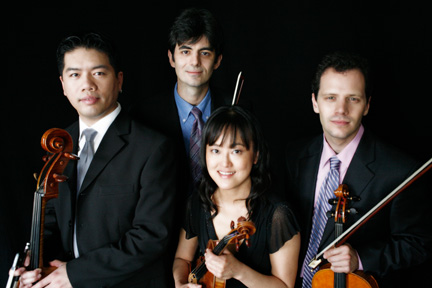
Avalon String Quartet performed Eduard Franck's String Sextet
CLOSE ENCOUNTERS WITH MUSIC
MAHAIWE PERFORMING ARTS CENTER
Great Barrington, Mass.
May 30, 2009
CELEBRATING MENDELSSOHN and DISCOVERING EDUARD FRANCK II
Review by Seth Rogovoy
(GREAT BARRINGTON, Mass., May 31, 2009) – Close Encounters with Music (CEWM) concluded its 2008-2009 series with the second of two programs devoted to Felix Mendelssohn, on the occasion of his 250th anniversary, and Mendelssohn’s little known protégé, Eduard Franck, whose String Sextet in E-flat major, Op. 41, was given its American performance premiere yesterday at the Mahaiwe.
CEWM’s Mendelssohn programs have also included works by others in his musical orbit, including Robert and Clara Schumann, and Mendelssohn’s sister, Fanny Mendelssohn Hensel, adding an essential degree of context with which to understand and appreciate his work and the work of Franck.
A sequence of Variations Concertantes for Cello and Piano, performed by CEWM artistic director Yehuda Hanani and James Tocco, respectively, began the evening, providing the musical baseline from which all other works heard would deviate.
Mendelssohn’s finely ordered lyricism was readily apparent, as was the influence of Johannes Sebastian Bach, whose reputation at the time of Mendelssohn’s writing was in eclipse, but for whom Mendelssohn was responsible for fostering a wholesale revival in interest.
But this wasn’t mere recapitulation: while Mendelssohn may have had one foot in the mathematical precision of Bach’s composition, his other was leading toward Romanticism and even beyond – in Tocco’s more freewheeling, syncopated passages, one heard glimpses of ragtime yet to come.
The forward-looking nature of much of the music played was to emerge as a theme, accidental or otherwise, of the evening. In the same variations, Hanani’s pizzicato duet with Tocco also had a jazzy syncopation, although his bow work boasted an appropriately parched, period feel.
Tocco tackled a set of solo piano pieces by the Mendelssohn siblings; Fanny’s in particular were fleet and athletic. Unfortunately, and by no fault of Tocco, these solo pieces were marred by unfortunately resonant and sustained high tones in the piano that apparently were feeding back into a p.a. system that also sent out a continuous low-level buzz throughout the evening that impeded the appreciation of softer, quieter passages.
Schumann’s Piano Quartet in E-flat major, Op. 47, was a vibrant display of Romanticism that even foreshadowed modernism, particularly in the Andante cantabile movement.
Schumann also may have been the patron saint of art rock; his orchestrations for four parts, featuring Tocco, Hanani, violinist Yehonatan Berick and violist Anthony Debroye, could easily be transcribed for a rock quartet, and its influence on acts ranging from the Beatles to the Electric Light Orchestra and Randy Newman was transparently clear.
The quartet packed organic peaks and valleys and ebbs and flows that passed effortlessly among the soloists, who were especially empathetic in their voicings.
After intermission, the Avalon String Quartet joined Hanani and Berick to perform the Sextet by Franck. As played, the piece demonstrated Franck’s strengths and weaknesses. He was an incredibly forward-thinking composer, using Eastern European and Middle Eastern modalities, sometimes with a Gypsy feel, while maintaining his Central European roots.
His music drew more on folk than did Mendelssohn and Schumann, an approach composers would continue to explore for the next two hundred years.
The form of the sextet allowed for greater color and depth to the music, and Franck more liberally allowed tempos to vary. The players responded by elongating lines to allow them to breathe more organically, a far cry from Mendelssohn’s Bach-derived clockwork. In Franck’s Andante movement, some of his passages portended the Minimalism of 150 years hence in their heavy use of chromaticism and staccato repetition.
By the onset of the third movement, the Scherzo, however, Franck’s limitations had grown readily apparent. As was the case with his Piano Trio, performed earlier in February, Franck lacked a strong, driving narrative of the sort that characterized the work of the Mendelssohns and Schumann.
The enthusiasm of the players, however, powered the piece in spite of its lack of a major, coherent statement, and it was a joy to see the esprit de corps among them, taking great pleasure in each other’s work as they communicated through nods, smiles, and musical gestures that acknowledged what each was saying.
Seth Rogovoy is Berkshire Living’s editor-in-chief and award-winning critic-at-large.
|

 ...sites that work